
- 38 Views
- 4 Min Read
- (0) Comment
It wraps cigarettes, resists fire, marks sacred festivals, and sharpens leopard claws. The Maila tree is one of Sri Lanka’s dry zone’s most quietly extraordinary residents.
Meet the Maila Tree
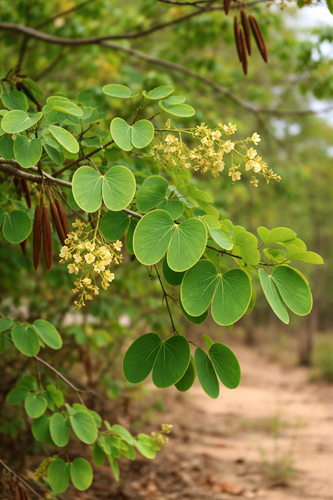
Its scientific name is Bauhinia racemosa, but in Sri Lanka’s dry zone, everyone simply calls it Maila. In English, it goes by the Bidi Leaf Tree — a name earned from one of its most ancient uses. Before modern cigarettes existed, the large, leathery leaves of this tree were used to hand-roll bidis, the traditional rural cigarettes of South Asia. The leaves were plucked, dried, and tied with a small thread around a pinch of tobacco. Durable and slow-burning, they were the rolling paper of the jungle.
But the bidi leaf is just the beginning of the Maila’s story.
The Tree That Never Sleeps — Or Rather, the One That Does
Watch a Maila tree as the sun goes down and you’ll witness something quietly remarkable. The two lobes of each leaf slowly fold together — like a book closing, or hands pressed in prayer. By nightfall, the whole canopy has drawn itself inward.
This behaviour is called nyctinasty — a plant’s response to the absence of light. For the Maila, it serves a practical purpose: by folding its leaves, the tree reduces water loss and shields itself from the cool night air. Come morning, the leaves open again, reaching back toward the sun.
It is one of those small natural spectacles that rewards the patient observer — a tree that visibly breathes with the rhythm of the day.
Fireproof by Design
Look at the trunk of a mature Maila and you’ll notice bark that is thick, dark, and deeply cracked — almost armour-like. This is no accident. Dry zone forests in Sri Lanka have always been shaped by fire, and the Maila has evolved accordingly. Its tough outer bark insulates the living tissue within, allowing the tree to survive ground fires that would kill less adapted species.
The inner bark tells another story. Beneath the rough exterior lie strong, flexible fibres that have long been used by villagers and jungle-dwellers to make impromptu rope. Need to lash together a shelter in the middle of the scrub? The Maila was the original hardware store — sturdy, reliable, and always within reach in the dry zone forest.
Sacred Gold: The Vijayadashami Legend
Just across the Palk Strait, the Maila tree is far more than a forest plant — it is sacred. During Dussehra (Vijayadashami), one of India’s most celebrated festivals, people exchange Maila leaves as a symbol of gold. The gesture — placing a leaf in a neighbour’s hands and offering it as a blessing of abundance — re-enacts an ancient legend.
It is said that before going into a long exile, warriors hung their weapons on this tree for safekeeping. When they returned victorious, they retrieved their arms and went on to reclaim their kingdom. The Maila became a symbol of that triumphant return — of wealth, courage, and new beginnings.
That a tree so common in Sri Lanka’s scrublands holds such deep ceremonial meaning just across the water is a quiet reminder of how intertwined the two countries’ natural and cultural histories are.
The Leopard’s Scratch Post
In the wild areas of Sri Lanka’s national parks, the Maila plays an unexpected role in the life of the island’s most iconic predator. Leopards are known to return repeatedly to the same Maila trunks — using the rough, ridged bark to sharpen their claws. The tree’s sturdy, deeply textured surface makes it ideal for the purpose.
If you ever spot deep parallel scratches on a Maila trunk at around shoulder height, you’re looking at evidence of a leopard’s regular patrol route. The tree, in its way, is a notice board — a territorial marker written in bark.
Distribution: A Dry Zone Specialist
The Maila is native to the Indian Subcontinent — found across India, Sri Lanka, and Pakistan — and extends into the dry forests of Myanmar and Thailand. It is a specialist of dry deciduous forests: heat-tolerant, drought-hardy, and capable of thriving in poor, rocky soil where most trees would struggle to survive.
In Sri Lanka, it is widely distributed across the Dry and Intermediate zones. It is a common presence in the scrub jungles surrounding national parks like Yala, Udawalawe, and Wilpattu. Between February and June, it produces small, creamy-white to pale yellow flowers — subtle compared to its more flamboyant relative, the Orchid Tree (Bauhinia variegata), but with a quiet advantage: the Maila’s flowers are intensely fragrant at night, evolved specifically to attract moths in the darkness.
The Symbol of the Scrub
In the layered ecology of Sri Lanka’s dry zone forests, different trees occupy different roles. Tall canopy giants like the Palu cast shade from above. But it is the Maila that holds the rugged middle layer — the dense, thorny scrub zone where deer and wild boar shelter from the midday heat.
It is not the tallest tree, nor the most showy. But strip the dry zone of its Maila trees and you’d lose the rope, the shade, the leopard’s scratch post, the moth’s midnight perfume, and a living link to one of South Asia’s most ancient festivals.
That is what makes the Maila one of the dry zone’s most essential — and most overlooked — trees.
Scientific name: Bauhinia racemosa · Family: Fabaceae · Common names: Maila, Bidi Leaf Tree · Found in: Dry and Intermediate zones of Sri Lanka, India, Pakistan, Myanmar, Thailand



Leave a comment: