
- 38 Views
- 4 Min Read
- (0) Comment
Long before British ships brought tea to Ceylon, a bright yellow shrub was already brewing in village pots. Meet Ranawara — the dry zone’s most resilient pharmacy.
The Plant That Outlasts the Drought
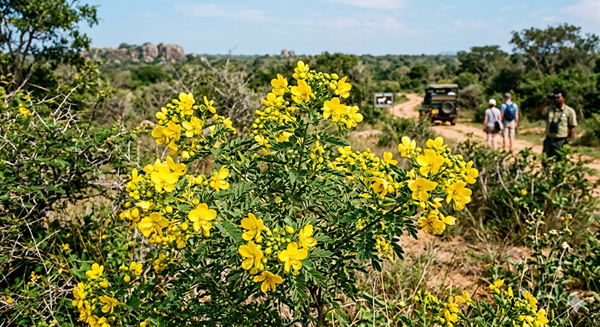
Walk through the dry scrublands of Sri Lanka’s southern and northern plains in the height of the dry season — the landscape is all thorns, dust, and cracked earth. Yet scattered among the parched scrub, you’ll find bursts of vivid yellow: Ranawara in bloom. While everything around it withers, this stubborn little shrub flowers almost year-round, unfazed by heat that would kill most plants.
This drought defiance is no accident. Ranawara (Senna auriculata), commonly known as Tanner’s Cassia, is built for Sri Lanka’s dry zone — the coastal belts of Hambantota, the scrublands of Mannar, the open plains of Jaffna. It is a plant that has co-evolved with some of the harshest climates the island has to offer.
Before There Was Tea, There Was Ranawara
Sri Lanka is synonymous with tea — but that story only began in the 1860s. For centuries before the British introduced Camellia sinensis, the island’s most beloved hot drink was brewed from Ranawara flowers. Early European travellers around Matara and Hambantota were so surprised to find locals preferring it over imported black tea that they recorded it in their botanical notes as “Matara Tea.”
Even today, villagers in the dry zone brew Ranawara tea to cool their bodies under the harsh sun — a tradition stretching back over a thousand years, documented in palm-leaf Ola manuscripts.
The tea is naturally caffeine-free with a mild, earthy taste. It was — and still is — the drink of hospitality. Offering a bowl of warm Ranawara to a traveller arriving from a long journey was a traditional gesture of welcome: not just refreshment, but a “coolant” to help the visitor recover from the Sri Lankan heat.
A Living Pharmacy: Medicinal Uses
In Ayurvedic tradition, Ranawara is most celebrated for its “cooling” properties — the idea that it helps regulate the body’s internal temperature. It has long been used to treat urinary tract issues caused by dehydration, a common complaint during the long dry months. But its uses extend well beyond that:
- Skin health — Used in traditional formulations for skin conditions and general complexion support.
- Blood sugar control — Studied in modern research for its potential role in managing blood glucose levels.
- Internal cooling — A classic herbal remedy for heat exhaustion and dehydration-related complaints.
- Detox drinks — Brewed as a cleansing herbal infusion in village wellness traditions across the island.
Ranawara has been recorded in Sri Lankan palm-leaf manuscripts (Ola leaves) for over a thousand years and is classified as an indigenous medicinal plant in the Ayurvedic tradition.
A Butterfly Factory
Ranawara is far more than a medicinal plant — it is a critical part of Sri Lanka’s dry zone ecosystem. It serves as a host plant for several butterfly species, most notably the Lemon Migrant and the Mottled Emigrant. The caterpillars of these species feed on the leaves, making each Ranawara shrub a living nursery for some of the island’s most beautiful winged creatures.
Look closely at the leaves of a flowering Ranawara in the wild — you may find the entire life cycle of a butterfly playing out on a single plant.
From Sri Lanka to the World: The Tanning Legacy
Ranawara’s story isn’t just a local one. Its bark is extraordinarily rich in tannins — the natural compounds used to convert raw animal hides into supple, durable leather. In the 1800s and early 1900s, before synthetic chemicals were invented, global leather production depended almost entirely on plant-derived tannins.
This made Ranawara an industrial heavyweight. India alone produced nearly 50,000 tons of dried Ranawara bark annually for the global leather trade. The world’s shoes, saddles, and bookbindings quite literally depended on this small yellow shrub.
So valuable was the plant that European colonial powers introduced it to several African nations — including Tanzania, Ghana, and Nigeria — to establish dedicated tanning plantations. What began as a dry zone wildflower had quietly become a global industrial crop.
Distribution and History in Sri Lanka
In Sri Lanka, Ranawara is almost exclusively a dry zone plant. It thrives in the thorny scrublands of the Southern Province and the open coastal belts of the North — you won’t find it growing naturally in the wet highlands of Kandy or Nuwara Eliya.
Ranawara is also deeply connected to South Asian cultural identity beyond Sri Lanka. It is the State Flower of Telangana, India, and is widely found in the dry zones of Tamil Nadu and Myanmar.
Today in Sri Lanka, you’ll encounter it in two forms:
- Wild — Growing freely in the thorny scrub of national parks and dry zone reserves.
- Cultivated — Kept in home gardens across the South and North as a “living pharmacy” for the family.
A Plant Worth Knowing
Ranawara is one of those rare plants that sits at the intersection of ecology, history, medicine, and culture. It fed caterpillars, tanned the world’s leather, cooled the bodies of travellers, and filled village pots long before commercial tea existed. It is drought-proof, caffeine-free, and quietly extraordinary.
The next time you spot a burst of yellow flowering in the dry scrublands of Sri Lanka, you’re looking at one of the island’s most storied and resilient survivors.
Scientific name: Senna auriculata (syn. Cassia auriculata) · Family: Fabaceae · Common names: Ranawara, Tanner’s Cassia, Matara Tea · Found in: Dry zone of Sri Lanka, southern India, Myanmar


Leave a comment: