
- 26 Views
- 4 Min Read
- (0) Comment
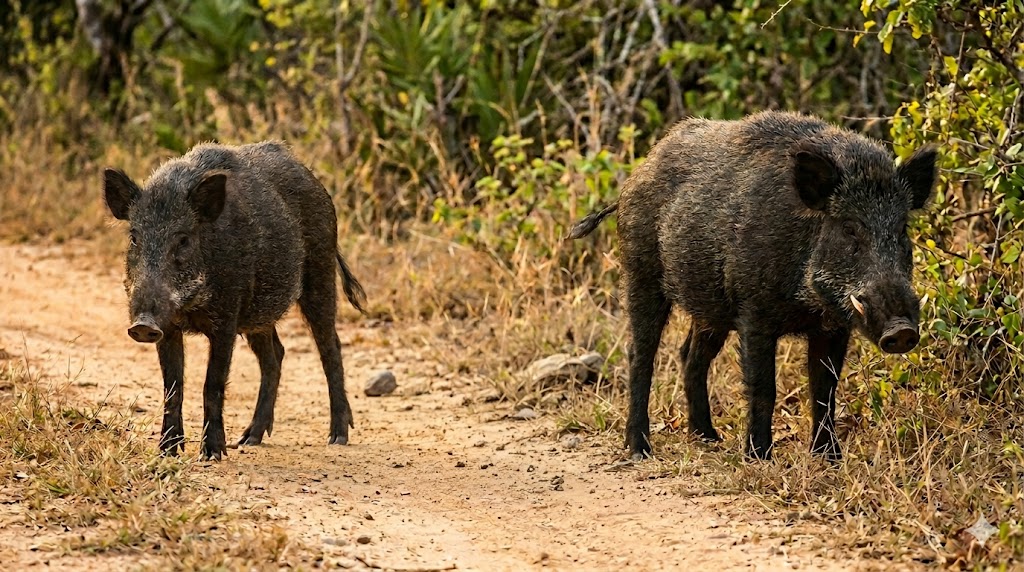
If you are tracking wildlife along the dusty boundaries of Sri Lanka’s dry zone, you will likely encounter areas where the earth looks as though it has been aggressively tilled by a mini-tractor. The ground is churned up, roots are exposed, and mud is splattered across the base of nearby trees. This is the unmistakable work of the Sri Lankan wild boar (Sus scrofa cristatus), or වල් ඌරා (Wal Oora).
Stocky, powerful, and fiercely intelligent, the wild boar is far from a simple forest pest. It is a highly adaptable survivor, a key ecosystem engineer, and one of the most formidable, heavily armed characters navigating the scrublands.
The Ultimate Plow: Built to Forage
The wild boar is essentially a compact tank engineered for maximum efficiency. While females (sows) are smaller and slimmer, weighing between 40 to 70 kg, an old male (boar) is a massive force, tipping the scales at up to 110 kg with a heavily ridged, muscular shoulder armor designed to absorb impacts.
Their most impressive tool, however, is their face. The boar possesses a long, prominent snout tipped with a disk of tough cartilage, driven by incredibly strong neck muscles. This allows them to effortlessly plow through hard, sun-baked soil to uncover hidden treasures that other animals cannot reach.
Nature’s Master Recyclers
Wild boars are true opportunists, possessing one of the most diverse omnivorous diets in the animal kingdom. Their foraging style acts as a vital ecological service, turning over the topsoil, aerating the earth, and actively dispersing seeds across the forest floor.
-
Underground Wealth: They use their snouts to unearth deeply buried roots, tubers, earthworms, and beetle larvae.
-
The Seasonal Sweet Tooth: Like the deer and bears of the dry zone, boars eagerly gather beneath Palu (Manilkara hexandra) and Wood Apple trees to devour fallen fruits.
-
The Clean-Up Crew: They are highly opportunistic scavengers. If they stumble upon carrion, or happen to catch small frogs, snakes, and eggs, they will consume them without hesitation.
The Secret Life of a “Sounder”
Wild boars have a deeply fascinating social structure. While mature males are strictly solitary wanderers, the females are highly gregarious. They live in tight-knit, cooperative family groups known as sounders.
A sounder typically consists of a few breeding females, their subadult offspring, and lines of tiny piglets. These mothers are intensely protective; if a predator gets too close to the nursery group, the sows will form a defensive wall, charging aggressively to protect their young.
The Camouflaged Squeakers
If you look at a wild boar piglet, you would never guess what it grows up to look like. While adults wear a coarse, bristly coat of dark brown or black hair, newborn piglets look like furry, walking watermelons.
They are born with a soft, light-brown coat painted with distinct cream and dark brown horizontal stripes running the entire length of their bodies. This pattern provides flawless camouflage when they lie perfectly still in dense brush or tall grasslands, rendering them virtually invisible to the sharp eyes of a hunting leopard. By four to five months of age, these juvenile stripes completely fade away into a uniform dark brown.
Razor-Sharp Defense: The Weaponry of the Tusk
Despite being a primary food source for the Sri Lankan leopard, a wild boar is never an easy meal. Adult boars are armed with continuously growing, razor-sharp canine teeth that curve outward from their jaws—their signature tusks.
These tusks don’t just look intimidating; they are self-sharpening weapons. As the upper and lower tusks rub against each other whenever the boar opens and closes its mouth, the edges become sharp enough to slice through thick hide.
When cornered by a predator or challenged by a rival male during the breeding season, a boar will lower its head and slash upward with incredible speed and power, capable of inflicting severe, life-threatening injuries to even the most experienced apex predators.
Where to See the Sounders
Because they are highly adaptable and resilient, wild boars hold a conservation status of Least Concern. They are found across almost every climatic zone in Sri Lanka, frequently moving out of the deep forests to forage along agricultural fringes at night before retreating into deep thorn bushes and hidden mud wallows to cool off during the heat of the day.
| Quick Guide | Wild Boar Profile |
| Scientific Name | Sus scrofa cristatus |
| Lifespan | 10 to 14 years in the wild |
| Gestation | Roughly 3.8 months (~115 days) |
| Top Viewing Parks | Yala, Wilpattu, Udawalawe, and Kumana National Parks |
Watching a large sounder emerge from the scrub at dusk, with a dozen striped piglets trotting in perfect alignment behind a massive matriarch, is an iconic sight of the Sri Lankan wild—a testament to one of the island’s most resilient and successful survivors.
Leave a comment: