
- 3 Views
- 4 Min Read
- (0) Comment
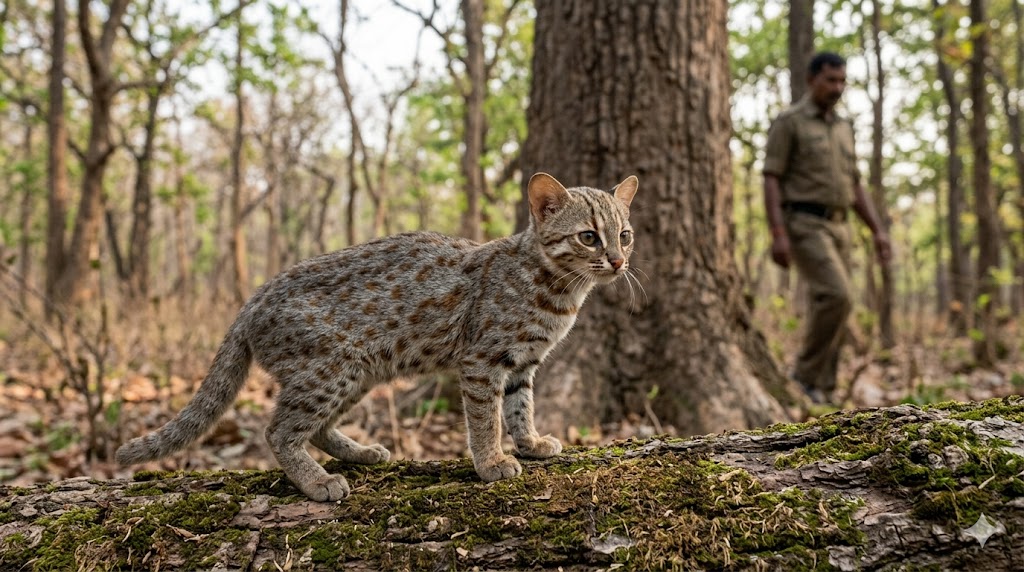
If you thought domestic kittens were small, meet the animal that holds the undisputed title of the smallest wild cat species in the entire world. Weighing roughly half as much as an average household cat, the Sri Lankan rusty-spotted cat (Prionailurus rubiginosus) is a pocket-sized powerhouse.
Known in Sinhala as the කොලදිවියා (Kola Diviya), this miniature predator is essentially a leopard scaled down to micro-proportions. What it lacks in physical size, it more than makes up for with a bold, fiercely active personality, lightning-fast reflexes, and an astonishing ability to conquer almost every corner of Sri Lanka.
An Evolutionary Shape-Shifter
While rusty-spotted cats on the Indian mainland are generally confined to dry grasslands and open scrub, the Sri Lankan populations have pulled off an incredible evolutionary feat. They have adapted to thrive in virtually every single habitat the island has to offer.
You can find them hunting among arid coastal dunes, navigating the hot dry-zone scrublands, hiding in lowland rainforests, and even prowling the dripping, high-altitude montane cloud forests of the central hills. When navigating these diverse terrains, they show off incredible climbing skills—if startled, they can run up vertical tree trunks with the fluid speed and squirrel-like agility.
Anatomy of a Pocket Predator
An adult rusty-spotted cat is exceptionally miniature, standing just 20 to 25 cm at the shoulder. Fully grown females are incredibly delicate, weighing a mere 0.9 to 1.4 kg, while males are only marginally heavier at 1.5 to 1.8 kg.
-
The Coat: Their short, soft fur is a beautiful grayish-brown, covered in rows of elongated, rust-colored (rufous) spots that run along the back and flanks. Their chest and underbelly are clean white, dappled with solid black spots.
-
The Face: Four distinct dark lines extend over the crown of the head. Most strikingly, two brilliant white streaks frame the inner borders of their massive, highly luminous amber-colored eyes, which are designed to maximize every photon of moonlight.
Squirrel-Sized Kittens and Secretive Dens
Rusty-spotted cats are strictly solitary and territorial, living completely alone within small home ranges. They meet only briefly during the spring breeding peak between February and April.
[Den in Hollow Log/Tree Cavity] ➔ [1 to 2 Blind, 40g Kittens Born] ➔ [Spots emerge from dark smudges] ➔ [Independent at 5–6 Months]
Mothers select highly secure, insulated dens inside hollow logs, tree cavities, or rocky crevices. Following a two-month gestation period, they give birth to just 1 or 2 kittens. At birth, these tiny infants are blind, helpless, and weigh an unbelievable 40 to 50 grams—making them smaller than a golf ball.
Initially, their fur is fluffier and darker than their parents’, with their signature rust-colored spots appearing only as faint, dark smudges. By two months, their bright adult rufous tones emerge completely. Raised exclusively by the mother, they swap milk for tiny mice and crickets at 5 weeks, mastering their agile hunting skills to become independent by 5 to 6 months of age.
Night Patrol on the Forest Floor
While they are magnificent climbers, rusty-spotted cats do the vast majority of their actual hunting on the ground. They are strictly nocturnal phantoms, sleeping during the day inside deep thorn thickets, tree hollows, or even the abandoned ceiling spaces of rural forest homes.
Under the cover of total darkness, they become hyper-focused carnivores. They use explosive bursts of speed to ambush a menu of small creatures:
-
Mammals & Birds: House mice, field rats, gerbils, and small roosting songbirds.
-
Reptiles & Invertebrates: Small geckos, garden lizards, tree frogs, land snails, and large insects like grasshoppers.
Because of their tiny size, they must stay alert. They are easily preyed upon by large birds of prey (like the forest eagle-owl), large pythons, jackals, and domestic dogs. Even the Sri Lankan leopard will kill them as a competitor if their paths cross.
The Hidden Perils of a Mini Cat
Currently listed as Near Threatened by the IUCN, this pocket-sized feline is heavily protected under Sri Lankan law. Because they live so close to agricultural and urban fringes, they face severe man-made threats:
Habitat Fragmentation: Draining marshes and clearing scrub forests or old-growth trees for farmland robs them of essential nesting cavities.
The Juvenile Leopard Mistake: Because of their spotted coats, terrified villagers frequently misidentify them as baby leopards and kill them out of fear or in retaliation for raiding backyard chicken coops.
Roadkills & Domestic Diseases: Their tiny size makes them almost invisible to drivers on rural roads at night. Furthermore, roaming domestic cats transmit deadly feline diseases, while stray dog packs pose a lethal threat to hunting adults.
| Fact Sheet | Rusty-Spotted Cat Specifications |
| Scientific Name | Prionailurus rubiginosus |
| Sri Lankan Subspecies | P. r. rubiginosus (Dry Zone) & P. r. phillipsi (Wet Zone Endemic) |
| Head-to-Body Length | 35 to 48 cm (Tail adds another 15 to 30 cm) |
| Lifespan | 8 to 10 years in the wild (Up to 15 years in captivity) |
Spotting the Invisible Cat
To see a rusty-spotted cat in the wild requires an immense amount of luck. They are so small, silent, and nocturnal that even seasoned safari guides rarely spot them without a camera trap.
However, two distinct populations exist on the island. The specialized wet-zone subspecies (P. r. phillipsi) leaves footprints in the cloud forests of Horton Plains and the dense rainforests of Sinharaja and Peak Wilderness. Meanwhile, the dry-zone variant can be looked for during night safaris or twilight drives along the borders of Yala, Wilpattu, Udawalawe, and Bundala National Parks, where they flit through the arid coastal scrub like a spotted shadow.
Leave a comment: