
- 18 Views
- 4 Min Read
- (0) Comment
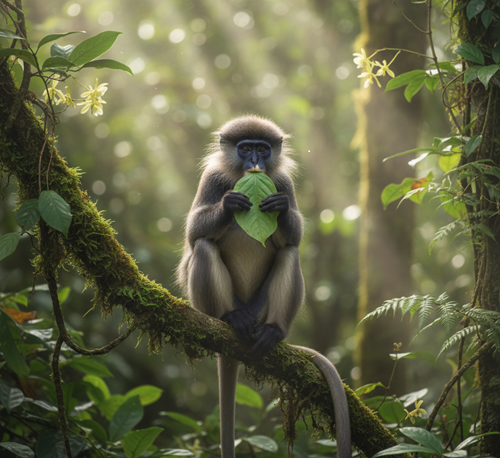
If you step into the emerald depths of a Sri Lankan rainforest at daybreak, the first sound to greet you isn’t the song of a bird, but a haunting, rhythmic explosion of deep, resonant whoops echoing through the mist. This spectacular acoustic display belongs to the island’s most majestic and secretive primate: the Sri Lankan purple-faced langur (Semnopithecus vetulus), known locally as the ශ්රී ලංකා කළු වදුරා (Kalu Vandura).
Exclusively endemic to Sri Lanka, this striking monkey is a true creature of the sky. Unlike the mischievous macaques that boldly wander temple grounds and roadsides, this shy, highly specialized leaf-eater spends almost its entire life high in the forest canopy, reigning over a vanishing world of treetops.
A Masterpiece of Canopy Adaptation
The purple-faced langur looks like a creature born from a fantasy novel. They possess a long, elegant tail that acts as a vital counterbalance as they leap through the upper branches, and a deep charcoal-to-black coat that contrasts sharply with a pale patch on their rump.
Their most defining feature is their face—a dark, purplish-black visage beautifully framed by a thick, flared crown of white-to-grey whiskers and a distinguished beard.
While dominant males grow larger and bulkier (weighing 6 to 8 kg) with broad faces to defend their territory, the entire species is anatomically engineered for a very specific lifestyle:
-
The Leaf-Eating Specialist: Unlike many primates that hunt for insects or gorge purely on sugary fruits, the langur is an obligate folivore (leaf-eater). Their diet consists almost entirely of young, tender leaves, buds, and forest fruits like figs.
-
A Specialized Digestive System: Digesting tough, fibrous leaves requires an incredibly complex stomach. The langur possesses a sacculated (multi-chambered) stomach containing specialized bacteria to break down cellulose and neutralize plant toxins—essentially acting like a high-altitude, arboreal cow.
The Birth of a White Infant
The social life of a langur troop—typically a cohesive family unit of 5 to 15 individuals led by a single dominant male and a sisterhood of breeding females—revolves around quiet grooming sessions and gentle communication.
When a new generation arrives, the troop welcomes a striking visual transformation. Sambar deer and leopards have camouflaged young, but the purple-faced langur infant is born looking completely different from its parents.
Newborns are covered in a pale grey to nearly white coat, sporting a faint brownish tinge on their crown and a soft pink face. This brilliant contrast makes it incredibly easy for the mother and other females in the troop to keep a watchful eye on the infant in the dimly lit rainforest canopy. By four to five months of age, this snowy baby fur completely fades, transitioning into the regal, dark coloration of an adult.
Four Worlds: A Fragmented Subspecies
Because Sri Lanka features incredibly diverse microclimates, the purple-faced langur has evolved into four distinct geographic subspecies, each facing a completely different survival reality:
| Subspecies | Common Name / Region | Key Habitat |
| S. v. vetulus | Lowland Wet Zone Langur | Deep rainforests like Sinharaja and Kanneliya |
| S. v. monticola | Montane Langur (Bear Monkey) | Freezing, mossy cloud forests of Horton Plains |
| S. v. philbricki | Dry Zone Langur | Forested historical reserves of Polonnaruwa and Ritigala |
| S. v. nestor | Western Purple-faced Langur | Heavily urbanized suburban patches around Colombo |
The Crisis in the Canopies
While the dry zone and montane subspecies enjoy some safety inside major national parks, the purple-faced langur is facing a quiet, catastrophic crisis, earning it a tragic placement on the Endangered species list.
Unlike generalist monkeys, these langurs are biologically bound to the treetops. They are reluctant to descend to the forest floor, where they feel completely vulnerable. As Sri Lanka’s wet zone forests are cleared for tea plantations, housing, and infrastructure, the canopy is shattered into isolated islands of trees.
The Modern Hazards: To move between fragmented gardens or forest patches, langurs are increasingly forced into dangerous territory. Attempting to cross gaps by leaping onto uninsulated power lines results in frequent, fatal electrocutions. When forced to drop to the ground to cross roads, their slow, awkward terrestrial gait makes them incredibly easy targets for feral dog attacks.
Glimpsing the Shaman of the Trees
For wildlife travelers, seeing a purple-faced langur in the wild is a profound experience. While you can see the shaggy, thick-coated “Bear Monkey” subspecies in the chilly plains of Horton Plains National Park, tracking the nominate species through the ancient, towering dipterocarp canopies of Sinharaja Rain Forest Reserve offers a glimpse into the true, wild heart of prehistoric Sri Lanka.
To look up and see a family of these bearded primates effortlessly navigating the canopy 30 meters above the ground is to realize just how vital it is to protect the continuous, unbroken forests they call home.
Leave a comment: