
- 24 Views
- 3 Min Read
- (0) Comment
If you have ever spent a quiet afternoon parked beneath a canopy of large trees in Sri Lanka’s dry zone, you have likely witnessed a sudden, spectacular aerial display. One after another, large, long-limbed monkeys launch themselves into thin air, crashing through leaves and effortlessly landing on slender branches that bend under their weight.
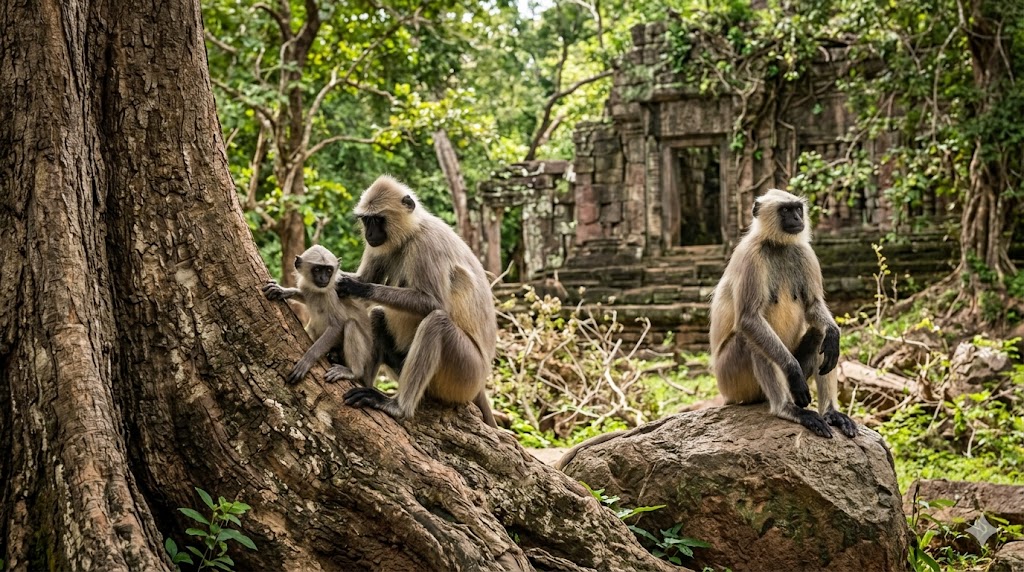
This is the Sri Lankan tufted gray langur (Semnopithecus priam thersites), known locally as the හැලි වඳුරා (Hali Vandura). Sharing the island’s forests with the smaller, more mischievous toque macaque, this endemic subspecies is the true gentleman of the canopy—dignified, highly organized, and an indispensable part of the dry zone ecosystem.
The Punk Rock Primate: Anatomy and Grace
The tufted gray langur is a medium-sized primate designed for high-altitude acrobatics. They sport a elegant silvery-gray coat that contrasts sharply with their jet-black face, hands, and feet.
However, their most unmistakable feature is on top of their head: a prominent, pointed tuft of hair on the crown that looks like a natural mohawk.
While females are slighter and more delicate (weighing 6 to 8 kg), the dominant males are muscular powerhouses tipping the scales at up to 12 kg. They use their long, slender limbs and exceptionally long tails to maintain perfect balance as they sprint across the canopy or drop down to the forest floor to forage.
From Dark Shadows to Silver Spirits
Like their rainforest cousins, the purple-faced langurs, tufted gray langur troops are tight-knit family structures consisting of 10 to 25 individuals. Social harmony within the troop is strictly maintained through continuous grooming, gentle vocalizations, and communal play.
When a new infant is born into the troop, it presents a fascinating evolutionary riddle. It looks absolutely nothing like its parents.
Newborn infants enter the world with very short, sleek, dark purplish-brown to blackish fur and a bright pink face. They completely lack the iconic pointed head tuft at birth. This dark coloration acts as a visual beacon, ensuring the mother and other “aunts” in the troop never lose sight of the baby in the shifting forest light. Within a few months, a beautiful transition occurs: the infant’s skin darkens to black, its fur shifts to a brilliant silver-grey, and that famous punk-rock crest begins to sprout.
The Ultimate Forest Telegraph
While they are highly herbivorous—spending their days carefully plucking young leaves, buds, and seasonal fruits like Palu (Manilkara hexandra) and figs—gray langurs are perhaps most famous for their role as the ultimate security guards of the jungle.
Because they spend so much time in the upper strata of the forest, they possess an unparalleled view of the landscape. While dominant males take up vigilant watch points on peripheral branches, they constantly scan the undergrowth for danger.
The Leopard Alarm: The moment a langur catches the fluid movement of a Sri Lankan leopard or the slither of a python, it unleashes a loud, harsh, barking alarm call. This deep “whoop” or “cough” acts as a definitive forest telegraph. Sambar deer, spotted deer, and wild boars below immediately halt their feeding and look to the langurs to gauge which direction the predator is traveling.
Coexisting with the Wilderness
Currently listed as Vulnerable, the tufted gray langur is heavily dependent on continuous dry zone forests and scrublands that feature plenty of tall sleeping trees. Because they are primarily leaf-eaters, they are less inclined to raid human kitchens or agricultural crops than macaques, making their interactions with humans generally peaceful.
| Quick Fact File | Langur Specifications |
| Scientific Name | Semnopithecus priam thersites |
| Endemism | Endemic Subspecies (Unique to Sri Lanka) |
| Lifespan | 20 to 25 years in the wild |
| Primary Diet | Folivorous (Leaves, shoots, wild fruits, and flowers) |
| Best Places to See | Yala, Wilpattu, Wasgamuwa, and Minneriya National Parks |
Whether you are watching a massive troop safely crossing an open glade in Wilpattu or listening to their booming alarm calls echo across the scrublands of Yala at dusk, the tufted gray langur is a captivating reminder of the intricate, cooperative networks that keep Sri Lanka’s wild spaces alive.
Leave a comment: