
- 18 Views
- 4 Min Read
- (0) Comment
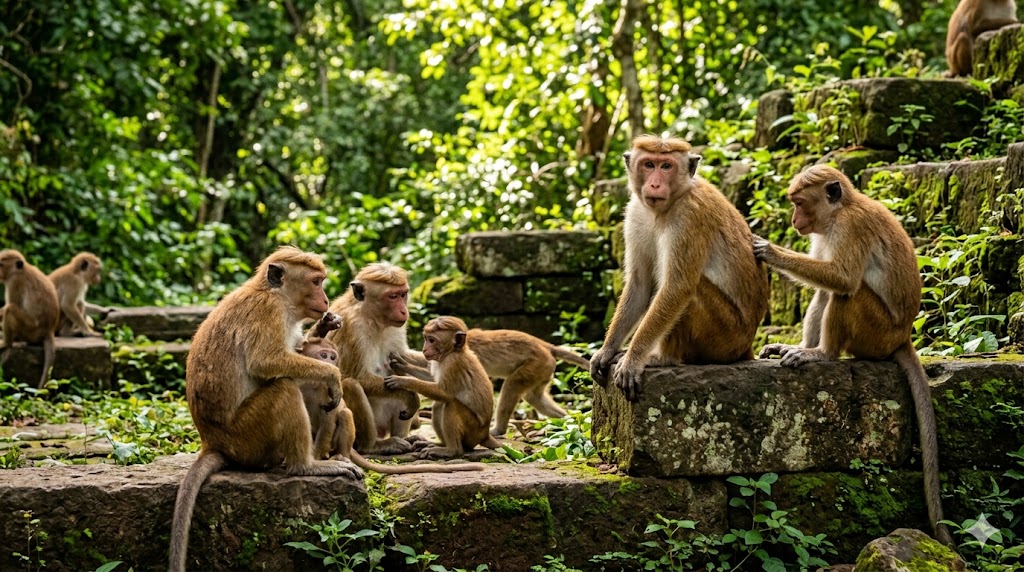
If you have ever visited an ancient temple ruin in Polonnaruwa or shared a roadside view in the central hills, you have undoubtedly met the island’s most famous personality. With a distinctive reddish-brown coat, a bright pink face, and a “haircut” that looks like a meticulously styled bowl cut, the Sri Lankan toque macaque (Macaca sinica) is impossible to miss.
Known in Sinhala as the රිලවා (Rilawa), these monkeys are entirely endemic to Sri Lanka. Unlike the shy, leaf-eating langurs that stick strictly to the high canopy, the toque macaque is a bold, highly intelligent opportunist that has mastered the art of living both in the treetops and on the forest floor.
A Society of Status: The Monkey Kingdom
Toque macaques are perhaps the most socially complex animals on the island. They live in large, boisterous troops of 10 to 40 individuals, and their lives are governed by a strict, almost royal hierarchy.
-
The Ruling Class: Every troop is led by a dominant alpha male and a select group of high-ranking females. Status determines everything—who gets the best sleeping branches, who eats first at a fruiting tree, and who gets groomed by whom.
-
The Power of Grooming: To the naked eye, it looks like they are just cleaning each other. In reality, grooming is the currency of macaque society. It reduces stress, settles arguments, and builds political alliances between families.
-
The Wanderer’s Journey: While females stay with their birth troop for life, young males are eventually forced to leave upon maturity. They often wander alone or in “bachelor groups,” waiting for the chance to challenge a leader and take over a troop of their own.
From Sparse Greys to Crowned Nobles
Macaque mothers provide dedicated parental care for up to two years. Because resources change drastically with the seasons, the troop’s breeding cycle is beautifully timed. While mating happens year-round, a highly defined birth peak occurs between February and April, ensuring that fragile newborns arrive exactly when forest fruits and flush vegetation are at their most abundant.
When these infants arrive, they look nothing like the regal, crowned adults of the troop.
Newborns enter the world with a very sparse, fine, dark bluish-gray coat and a bright pink face flanked by disproportionately large, prominent ears. Their iconic hair cap is missing at birth, initially appearing as nothing more than a small, fuzzy tuft. Over the course of 2 to 3 months, their skin darkens, their fur transitions, and that fuzzy tuft flattens out into the characteristic, styled adult disk pattern.
The Master Omnivore
While their neighbors, the gray and purple-faced langurs, are strictly vegetarian leaf-eaters, the toque macaque will eat almost anything. Their intelligence allows them to exploit an incredibly diverse menu across the dry and wet zones.
-
The Wild Hunt: In the forest, they forage for figs, berries, and young shoots. They are also adept predators of small animals, actively snacking on beetles, ants, frogs, lizards, and bird eggs.
-
The Human Connection: Because they are so adaptable, many troops have moved into agricultural fringes and urban spaces. They are notorious for raiding coconut plantations, banana groves, and paddy fields. At ancient sites, they have become expert “temple monkeys,” occasionally snatching snacks from unsuspecting tourists.
Nights in the Canopy
Despite their bold daytime behavior on the ground, toque macaques are highly vulnerable to nocturnal predators like leopards and large pythons. They build no permanent shelters or nests.
Instead, as twilight falls, the entire troop retreats into the upper canopy of large, sturdy trees or along secure rock ledges. Families huddle tightly together in dense clusters, using collective body warmth and the safety of numbers to survive the dark hours before the jungle wakes.
Facing a Fragile Future
Despite their presence everywhere, the toque macaque faces a quiet, severe crisis, earning it a placement on the Endangered species list. Their intelligence and adaptability are, paradoxically, part of their downfall.
As forests are cleared for farming and urban housing, macaques are forced into closer contact with humans. This leads to intense “human-monkey conflict,” as farmers protect their livelihoods from raiding troops. Combined with habitat loss and fragmentation, their populations are declining significantly.
| Fact File | Macaque Specifications |
| Scientific Name | Macaca sinica |
| Endemism | 100% Endemic to Sri Lanka |
| Lifespan | 20 to 30 years in the wild |
| Gestation | ~5.5 months (~165 days) |
| Top Viewing Parks | Polonnaruwa, Yala, Wilpattu, and Udawatta Kele |
Where to Witness the “Kingdom”
For a truly unforgettable experience, head to the ancient city of Polonnaruwa. Here, the macaques have lived among the archaeological ruins for generations and are remarkably habituated to people. Watching a complex troop navigate the ancient stone carvings or groom one another atop a sun-drenched stupa feels like stepping directly into a living history book.
Leave a comment: