
- 4 Views
- 4 Min Read
- (0) Comment
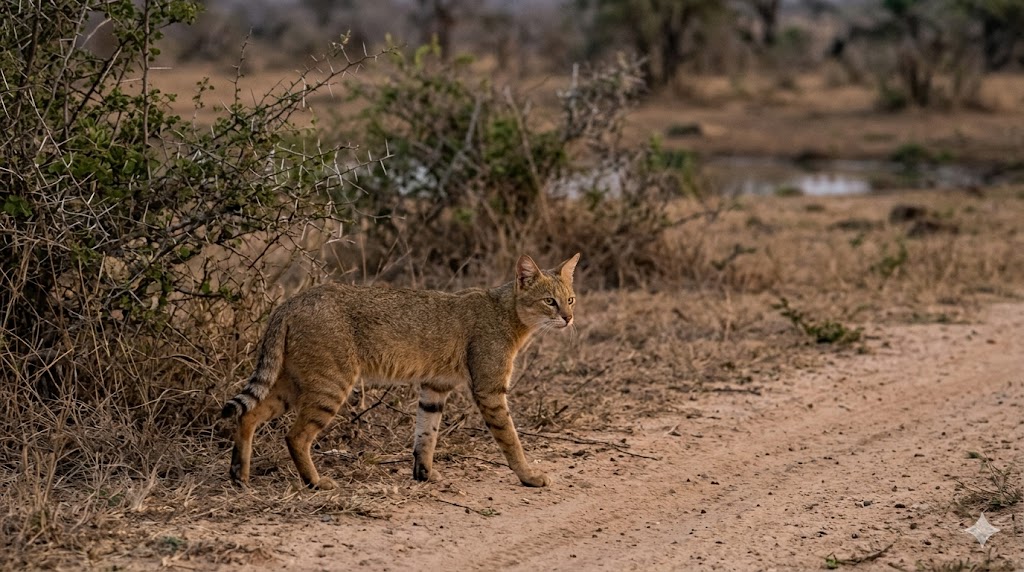
If you venture out onto the open, sun-drenched plains of Sri Lanka’s dry zone national parks, you might just spot a flash of sandy fur moving through the tall grass. While most of the island’s wild felines are strictly creatures of the night, hiding deep within dense forest interiors, there is one bold exception. The Sri Lankan jungle cat (Felis chaus kelaarti) is a diurnal predator, perfectly comfortable hunting in broad daylight.
This native subspecies has completely adapted to life in the open scrublands, grasslands, and lake fringes, avoiding dense rainforest interiors entirely. It is a sleek, charismatic predator that plays a critical role in the island’s lowlands.
The 2-Meter Sky Leap
Don’t let its relatively plain appearance fool you—the jungle cat possesses an astonishing physical superpower. Built with exceptionally long, powerful legs and a slender frame, it is the ultimate feline acrobat.
To hunt swift, flying prey like quails, francolins, or darting rodents, this cat doesn’t just stalk and pounce. From a completely stationary position, it can launch itself vertically up to 2 meters straight into the air, using its front paws to snatch flying birds right out of the sky.
[Cat spots flying bird] ➔ [Crouches in stationary position] ➔ [Explosive 2-meter vertical leap] ➔ [Snatches bird mid-air]
Sleek Adults and Striped Kittens
Adult jungle cats are medium-sized wild felines. Males weigh between 5 to 7 kg, while the slightly more compact females weigh 4 to 5 kg. They share an identical appearance: a uniform, unspotted sandy-brown coat, a relatively short tail (20 to 30 cm), a white throat, and distinctive, small black tufts of hair on the tips of their ears, reminiscent of a lynx.
However, their young enter the world looking completely different.
Following a two-month gestation period, mothers give birth to a litter of 1 to 3 kittens inside well-hidden dens—usually established in hollow logs, abandoned animal burrows, or dense reed beds. Kittens are born with a soft, dense coat covered in distinct, dark-brown stripes and spots. This heavy camouflage protects them while they are small and vulnerable. As they grow up, these markings fade away completely, leaving only a few faint dark rings on their tail and upper legs by the time they reach adulthood.
The mother exclusively provides parental care, nursing them for the first 2 to 3 months—supplemented curiously by soft, young green grass blades—and teaching them their signature agile hunting techniques until they become fully independent at around 5 to 6 months of age.
Solitary Stalkers of the Dry Zone
Outside of the short mating seasons—which peak twice a year around January–February and June–July—adult jungle cats are strictly solitary and highly territorial. They actively patrol a variety of open habitats across the Dry and Intermediate climatic zones, hunting a diverse menu of small animals:
-
The Staple Diet: Field rats, mice, gerbils, and large bandicoots.
-
The Opportunistic Catch: Black-naped hares, ground-nesting birds, marsh frogs, monitor lizards, and snakes.
While they hunt in the open, they must stay alert. The Sri Lankan leopard is their main natural predator and competitor, while large birds of prey (like the belly-banded eagle) and golden jackals constantly threaten unattended kittens.
Fringes of Danger: Human Threats
Currently listed as Near Threatened within Sri Lanka, the jungle cat faces several severe man-made hazards along the borders of its grassland habitats:
Habitat Conversion: The continuous clearing of open grasslands and scrub areas for intensive agricultural development and farming directly destroys their natural foraging grounds.
Retaliatory Poaching: Because they are highly opportunistic, jungle cats frequently wander into agricultural farmlands and are shot, trapped, or poisoned by villagers for raiding backyard chicken coops.
Domestic Dog Attacks: Both hunting adults and fragile kittens face severe injury or death from encountering aggressive packs of domestic or stray village hunting dogs.
| Fact Sheet | Jungle Cat Specifications |
| Scientific Name | Felis chaus kelaarti |
| Residency | Resident Breeder |
| Head-to-Body Length | 60 to 75 cm (Tail adds 20 to 30 cm) |
| Lifespan | ~12 to 14 years in the wild |
| Top Viewing Parks | Yala, Udawalawe, Wilpattu, Minneriya, and Kumana |
Where to Spot the High-Jumper
Because they are active during the day (diurnal) and during the twilight hours (crepuscular), your chances of spotting a jungle cat on a safari are surprisingly good if you know where to look. Keep your eyes trained on the open grasslands and wetland edges of Yala, Udawalawe, and Wilpattu National Parks. Watching one gracefully navigate the tall grass—or witnessing an explosive mid-air leap—is one of the most thrilling sights the Sri Lankan lowlands have to offer.
Leave a comment: