
- 24 Views
- 4 Min Read
- (0) Comment
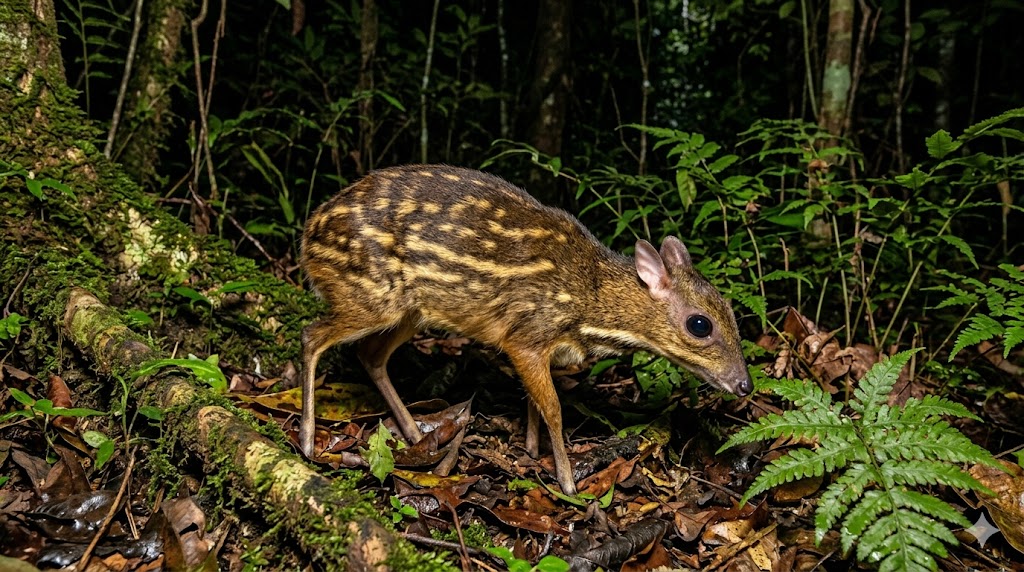
Tucked away in the dense, rain-drenched undergrowth of southwestern Sri Lanka lives an animal that seems to break all the rules of modern biology. It has the face of a mouse, the delicate, slender legs of a deer, the multi-chambered stomach of a cow, and—most surprisingly—the sharp, protruding fangs of a carnivore. This is the yellow-striped chevrotain (Moschiola kathygre), affectionately known as the wet-zone mouse-deer.
Known locally in Sinhala as the ශ්රී ලංකා කහ-ඉරි මීමින්නා (Kaha-Iri Meeminna), this tiny animal is a spectacular biological riddle. Though it looks like a miniature deer, it belongs to the ancient family Tragulidae. It wasn’t even recognized by modern science as its own distinct species until 2005, when researchers realized it was genetically and physically distinct from its dry-zone relative, the spotted chevrotain.
An Evolutionary Bridge with Dagger Teeth
The yellow-striped chevrotain is often called a “living fossil.” It represents an ancient branch of hoofed mammals that serves as an evolutionary bridge between non-ruminants (like pigs) and true ruminants (like modern deer).
Because they branched off so early on the evolutionary tree, male chevrotains never evolved antlers. Instead, they weaponized their teeth. Adult males grow elongated, razor-sharp upper canine teeth that extend downward past their lower lips like miniature daggers. When defending their small territories or fighting off rival males, they don’t lock horns—they launch into fierce, aggressive slashing and stabbing duels using these canine tusks.
Pocket-Sized Specs and Instant Camouflage
Weighing a mere 2.5 to 4.5 kg and measuring just 45 to 55 cm in length, these are among the smallest hoofed herbivores in existence. Interestingly, adult females are slightly larger and heavier than males. Both sexes sport a striking, glossy coat covered in an intricate network of yellowish-buff stripes and spots that run horizontally across their flanks, fading into a crisp white underbelly.
[1 Fragile Fawn Born] ➔ [Perfect Stripe & Spot Camouflage] ➔ [Hides Silently in Hollow Logs] ➔ [Matures Rapidly by 5-6 Months]
Breeding takes place year-round across the wet zone. Litters are strictly limited to a single fawn. Fawns are born as incredibly fragile, pocket-sized replicas of their parents, complete with the adult yellow-striped camouflage pattern from day one. To protect her vulnerable newborn, the mother leaves the fawn tucked away inside a dark, hidden thicket or hollow log, returning quietly only to nurse it until it gains full coordination. Growth is remarkably rapid; they reach full sexual maturity at just 5 to 6 months of age.
Phantom of the Forest Floor
Chevrotains are intensely solitary, non-social animals. They live entirely independent lives within small home ranges, interacting with other mouse-deer only during brief mating windows. They are primarily nocturnal and crepuscular, meaning they stay completely hidden during the day.
They build no permanent nests, choosing instead to rest inside hollow fallen logs, dense root cavities under ancient trees, or deep within tangled fern beds. At night, they step out to forage on high-quality, nutrient-dense plant matter dropped onto the forest floor:
-
Wild Fruits & Berries: Succulent fallen fruits and wild berries.
-
Forest Greens: Tender young leaves and fresh flowers.
-
Fungi: Rich forest mushrooms found along damp logs.
To avoid drawing the attention of predators, they are normally completely silent. However, if caught, startled, or severely threatened, they will let out a surprisingly loud, high-pitched, piercing squeal.
Hiding from a World of Predators
Because of their tiny size, mouse-deer sit squarely on the menu for almost every predator in the wet zone. They are heavily preyed upon by the Sri Lankan leopard, fishing cats, rusty-spotted cats, large pythons, land monitors, and large forest owls or eagles. Unfortunately, they face severe man-made threats that are actively closing in on their remaining habitats:
The Bushmeat Trade: This is currently their single greatest survival threat. They are intensively and illegally hunted across rural areas using traps, snares, and trained hunting dogs for their meat, which is considered a prized local delicacy.
Undergrowth Clearing: The clearing of thick rainforest undergrowth for tea cultivation, logging, and housing developments strips away the low-lying cover they completely depend on to hide.
Domestic Dog Packs: Mouse-deer populations that border villages or suburban wetlands are frequently chased down and killed by roaming packs of domestic or stray dogs.
| Fact File | Yellow-Striped Chevrotain Specifications |
| Scientific Name | Moschiola kathygre |
| Endemism | 100% Endemic to Sri Lanka |
| Conservation Status | Least Concern (Globally), but highly vulnerable locally |
| Lifespan | 6 to 9 years in the wild (Up to 13 years in captivity) |
Tracking the Secretive Meeminna
The yellow-striped chevrotain is strictly limited to the wet and intermediate climatic zones of southwestern Sri Lanka and the central highlands. They are entirely absent from the dry northern and eastern plains.
While seeing one in the dense rainforests of Sinharaja, Kitulgala, or the Peak Wilderness requires an extraordinary amount of luck and patience, they can surprisingly be found much closer to urban centers. Slow, quiet evening walks through the marshy fringes of the Thalangama Wetland or the protected thickets of the Bellanwila-Attidiya Sanctuary on the outskirts of Colombo offer some of the best chances to see this fanged, ancient survivor darting through the reeds.
Leave a comment: