
- 2 Views
- 5 Min Read
- (0) Comment
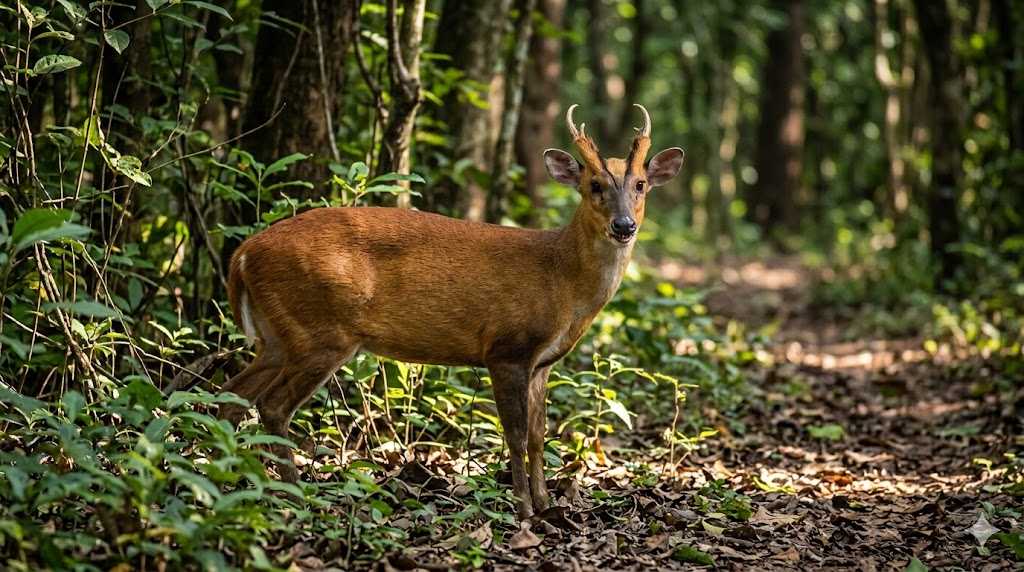
If you are trekking through the deep forest cover of Sri Lanka and a sudden, shockingly loud sound—resembling the deep, harsh bark of a large dog—slices through the trees, you haven’t stumbled upon a stray hound. You have just startled an Indian muntjac (Muntiacus muntjak). Known in Sinhala as the වැලි මුවා (Wali Muwa) or ඕලු මුවා (Olu Muwa), this small, secretive animal is widely referred to as the barking deer.
Far from being an ordinary deer, the muntjac is a living fossil. They are among the oldest known deer species on Earth, with fossil records stretching back millions of years. Shy, solitary, and intensely alert, they serve as a critical component of the island’s forest ecosystems.
Evolution’s Dual Weapons
Because muntjacs belong to an ancient lineage that evolved before modern deer developed massive, branching antlers, adult males carry a completely unique, primitive defense kit.
-
Long Bony Pedicles: Their antlers are short and simple single-tines (usually 7 to 12 cm long) that sit atop unusually long, skin-covered bony columns called pedicles that form dark, prominent V-shaped ridges down their faces.
-
Canine Tusks: Most surprisingly, males carry elongated, razor-sharp upper canine teeth that protrude downward out of their lips like miniature tusks. When defending their territories against rival males or slashing at smaller predators, they rely far more on these sharp, stabbing canine tusks than on their antlers.
Spotted Fawns to Red Sub-Adults
Weighing between 15 to 25 kg, muntjacs are medium-sized, glossy, reddish-chestnut deer with elegant, slender legs. Males and females look entirely different; females completely lack antlers and tusks, carrying small, dark, bristly tufts of hair where the male’s bony pedicles would be.
[1 Spotted Fawn Born Hidden in Brush] ➔ [Nursed Secretly for 2 Months] ➔ [Spots Fade at 4-6 Months] ➔ [Adult Chestnut Coat Appears]
Breeding occurs year-round, and pregnancies result in strictly one fawn. At birth, the fawn is covered in rows of tiny white camouflage spots running along its spine to blend into the dappled forest floor. Unlike Sri Lanka’s famously spotted axis deer (Axis axis), which keep their spots for life, a muntjac fawn’s camouflage fades completely within 4 to 6 months, replaced by a uniform, adult chestnut coat. The mother keeps her fawn carefully hidden in dense brush for its first few weeks, returning systematically to nurse it.
Forest Scent Marks and the “Leopard Alarm”
Muntjacs are strictly solitary and fiercely territorial. They live entirely alone within small, fixed patches of forest. To map out their boundaries, they use massive preorbital scent glands located just below their eyes. They pull these glands open to rub a pungent secretion onto branches and tree trunks, aggressively chasing off any same-sex intruders that wander across the line.
[Muntjac Senses Threat] ➔ [Emits Explosive Dog-Like Bark] ➔ [Repeats Barking for Over an Hour] ➔ [Alerts Entire Forest to Predator]
While they are mostly active during the day and twilight hours (crepuscular), they are incredibly difficult to see because they avoid wide open plains, choosing instead to stay under dense canopy cover. However, their presence is always known thanks to their famous vocal cords. When a muntjac catches the scent or sight of a predator, it unleashes an explosive barking call. A single alarmed muntjac can stand in one spot and bark continuously for over an hour, acting as a highly reliable, loud alarm system that alerts every animal in the jungle to danger.
Gourmet Herbivores of the Understory
While larger deer species graze heavily on coarse grasses, the barking deer is a highly selective browser. They possess a delicate, narrow muzzle designed to pick out nutrient-dense, easily digestible plant materials from the forest floor:
-
Tender Greens: Succulent young leaves, fresh forest shoots, and herbs.
-
Forest Sweets: Fallen wild fruits, berries, and nutritious tree seeds.
-
Fungal Delicacies: They are particularly fond of wild forest mushrooms, which provide a rich source of moisture and nutrients.
The Hidden Perils of the Footpath
Though classified globally as Least Concern, local muntjac populations face persistent, localized human pressures that threaten their survival outside deep wilderness zones:
The Bushmeat Trade: Because their venison is considered a premium choice in rural areas, muntjacs are heavily targeted by illegal commercial poachers operating along forest boundaries.
Wire Snares: Muntjacs are creatures of habit, walking along narrow, predictable footpaths through dense brush. Poachers exploit this by setting illegal wire snares along these tracks, which easily catch and lethally injure the deer.
Village Dog Packs: As villages push closer to forest boundaries, roaming packs of domestic and stray hunting dogs frequently enter the understory, chasing down and killing adult deer and vulnerable fawns.
| Fact File | Indian Muntjac Specifications |
| Scientific Name | Muntiacus muntjak |
| Activity Pattern | Diurnal and Crepuscular (Active during daylight and twilight) |
| Lifespan | 10 to 13 years in the wild (Up to 17 years in captivity) |
| Primary Natural Predators | Sri Lankan leopard, jackals (fawns), pythons, and mugger crocodiles |
Where to Hear the Ghost of the Woods
The barking deer is remarkably widespread across Sri Lanka, navigating ecosystems ranging from the hot, low-country coastal scrub to the highest montane cloud forests. Because they require heavy cover, they are rarely seen standing out in the open like spotted deer or sambar.
Instead, look for them along the shaded, thick forest edges of Wilpattu and Wasgamuwa National Parks, the riverine forests of Udawalawe, or stepping quietly through the mist-shrouded paths of Horton Plains National Park and the Knuckles Mountain Range. Keep your ears open—the forest will usually tell you exactly where they are hiding long before you see them.
Leave a comment: