
- 34 Views
- 4 Min Read
- (1) Comment
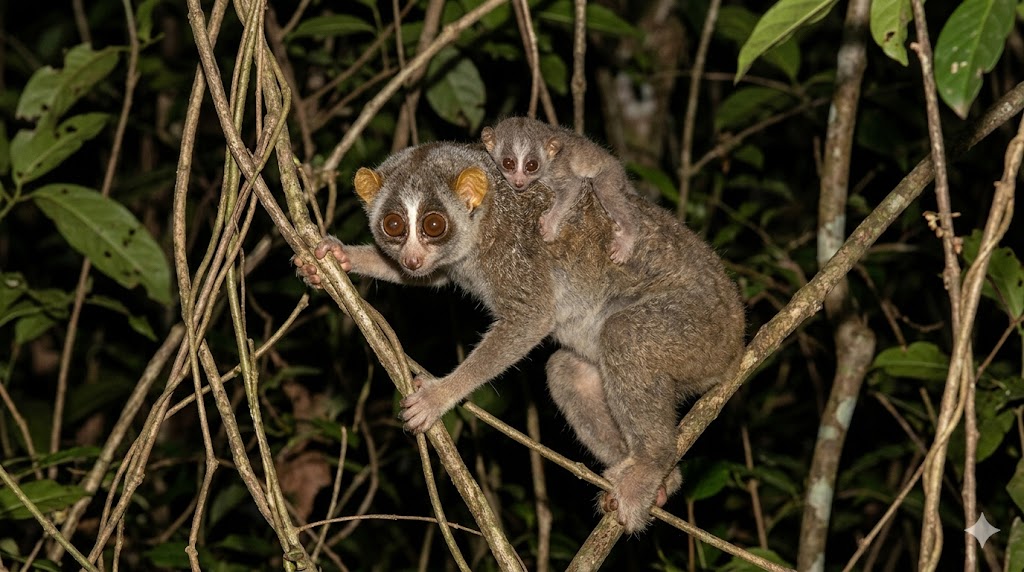
If you leave the wet, mist-shrouded rainforests of Sri Lanka and travel into the sun-baked northern plains, eastern scrublands, or the iconic dry-zone landscapes, you step into the domain of the gray slender loris (Loris lydekkerianus). Known in Sinhala as the අලු උණහපුලුවා (Alu Unahapuluwa), this fascinating primate is the larger, more robust cousin of the delicate red slender loris.
While it shares the same ghostly, deliberate crawling style and massive, light-gathering eyes, the gray slender loris is uniquely adapted to a entirely different world—thriving in dry deciduous forests, thorny acacia scrublands, and river-bordering gallery forests.
Evolution’s Toxic Secret
While the red loris relies on an eerie “cobra mimicry” dance to ward off danger, the gray slender loris packs a much more literal punch. They are among the very few mammals—and fewer primates—capable of producing a chemical defense mechanism.
On the inside of their upper arms, these lorises possess specialized brachial glands. When a loris feels threatened, it licks these glands, mixing the clear secretion with its saliva to create a mild toxin. They rub this pungent mixture all over the crowns of their heads, and mothers thoroughly coat their infants with it to repel biting ectoparasites and deter predators. If cornered, a gray loris will deliver a toxic bite that can cause severe, painful allergic reactions in humans and smaller animals alike.
Double Trouble: Twinning in the Scrub
Weighing in at 180 to 300 grams, the gray slender loris is noticeably sturdier than its red counterpart. Both sexes look identical, cloaked in a dense, woolly grayish-brown coat that provides flawless camouflage against the pale bark of dry-zone trees.
While breeding occurs year-round, distinct surges sweep through the populations from April to May and again from October to November. Following a gestation period of nearly six months, mothers give birth to their young.
[1 to 2 Silvery-Gray Infants Born] ➔ [Cling to Mother's Belly Fur] ➔ [Parked Together in Thorny Thickets] ➔ [Groomed by Dad and Siblings]
Interestingly, twin births are recorded far more frequently in the gray species than in the red. The infants are born fully furred with their enormous eyes wide open, sporting an incredibly fine, fuzzy, silver-gray coat. They spend their earliest weeks clinging like Velcro to their mother’s belly before she transitions them to nightly “infant parking.”
The Co-Op Day Care
While the red slender loris mother works largely alone, the gray slender loris operates within a surprisingly complex dispersed social network. A dominant male, one or two females, and their offspring maintain overlapping home ranges.
[Night: Hunt Solitarily to Avoid Insect Competition] ➔ [Dawn: Re-group to Sleep in Tight Furry Cluster]
To avoid competing for food, they fan out to hunt completely alone at night. But when the young are “parked” on a secure branch, the social magic happens: adult males and older siblings within the network actively guard, groom, and play with the parked infants. At dawn, the entire group communicates via high-pitched whistles and re-gathers to sleep through the heat of the day, tightly curled together into a single, defensive, furry ball inside a thorny bush or thick mass of lianas.
Hyper-Insectivores of the Canopy
The gray loris is highly predatory, favoring a diet packed with large, crunchy invertebrates. They use their needle-thin fingers and lightning-quick hand strikes to capture an array of prey:
-
Preferred Insects: Massive beetles, moths, caterpillars, crickets, grasshoppers, and stick insects. They are also known to raid aggressive ant columns on tree trunks.
-
Small Vertebrates: Tree frogs, geckos, garden lizards, small roosting birds, and defenseless nestlings.
-
Plant Supplements: Occasionally, they will lick nutritious sap or gum oozing from the bark of Acacia trees.
Invisible Highways Under Threat
Currently listed as Near Threatened, the gray slender loris is deeply impacted by human encroachment into Sri Lanka’s dry zones:
Loss of Thorn Scrub: Large-scale agricultural projects and expanding orchards frequently clear out the dense, thorny undergrowth and scrub forests that lorises rely on for safe nesting and sleeping sites.
The Ground Vulnerability: When tree canopies are severed by roads, lorises are forced down to the ground or onto live farm fences to cross gaps. On the ground, their slow crawl makes them easy targets for vehicles and roaming domestic dogs.
Poaching and Superstition: Just like their rainforest relatives, they are illegally captured for the exotic pet trade or killed due to traditional folklore, where their unique anatomy is targeted for charms and ritual medicines.
Where to Spot the Spotted Shadow
Because they favor more open, dry-zone vegetation, the gray slender loris is generally easier to spot with a spotlight than the wet-zone red loris. They are widespread across the northern, north-central, and eastern lowlands. Excellent locations for evening loris-watching walks or night safaris along forest fringes include Wilpattu, Minneriya, Kaudulla, and Wasgamuwa National Parks. Additionally, the strictly protected forests of the Sigiriya Sanctuary and the ancient, isolated hills of the Ritigala Forest Reserve offer fantastic opportunities to see their glowing eyes navigating the thorny canopy.

Comment 01
Albert3450,
10 October, 2026https://addlinks.pro/KHynP