
- 53 Views
- 4 Min Read
- (1) Comment
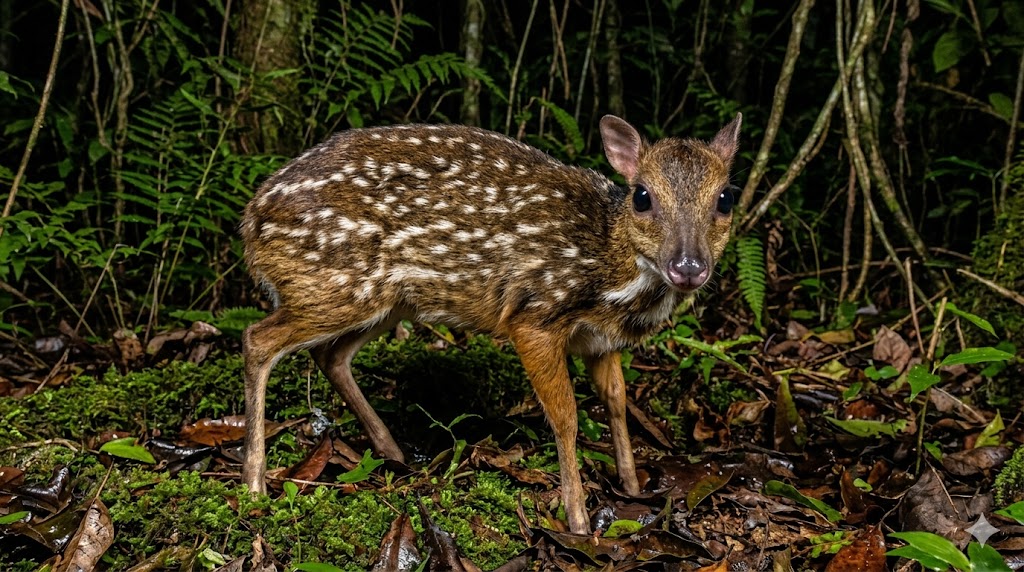
Deep within the shaded thickets of Sri Lanka lives an animal that looks like a whimsical creation of folklore—a creature with the dainty body of a mouse and the tiny, delicate hooves of a deer. This is the Sri Lankan spotted chevrotain (Moschiola meminna), universally known as the mouse-deer.
Do not let the common name fool you; it is neither a true mouse nor a true deer. It is a member of Tragulidae, an ancient, primitive family of hoofed mammals that split from modern ruminants over 30 million years ago and has remained virtually unchanged ever since. Known in Sinhala as the ශ්රී ලංකා තිත් මීමින්නා (Thith Meeminna), this little phantom is a true evolutionary time capsule.
Fangs and Underwater Escapes
Because chevrotains branched off long before modern deer developed heavy, branching antlers, evolution gifted them alternative means of survival.
-
Vampire Fangs: Adult males completely lack antlers. Instead, they carry elongated, razor-sharp upper canine teeth that project downward past their lower lip like miniature vampire fangs. When territorial disputes erupt between rival males, they engage in aggressive, fast-paced slashing matches using these hidden tusks.
-
The Scuba Trick: Even more astonishing is their secret escape tactic. If a spotted chevrotain is chased by a predator near a forest stream, it will fearlessly plunge into the water. Instead of swimming along the surface, it can completely submerge itself and literally walk along the riverbed floor, utilizing the water as a dense canopy to hide from land-based predators until danger passes.
Miniature Specs and Pocket Fawns
Weighing a mere 2.0 to 4.5 kg and measuring 50 to 60 cm in length, the spotted chevrotain is exceptionally pint-sized. In keeping with their primitive ancestry, adult females are slightly larger and heavier than males. Their coats are a masterpiece of camouflage, featuring a smooth, rich brown canvas dappled with brilliant white spots that merge into unbroken horizontal stripes along the flanks.
[1 Fragile Fawn Born] ➔ [Perfect Spot & Stripe Camouflage] ➔ [Hidden Alone in Hollow Logs] ➔ [Matures Rapidly by 5-6 Months]
Breeding occurs year-round, with females giving birth to strictly one fawn per litter. Fawns are born as exact, pocket-sized replicas of their parents, sporting the identical spot-and-stripe pattern. To keep her newborn safe from the forest’s many eyes, the mother keeps the fawn tucked away inside a dark, hidden thicket or hollow log, visiting quietly only to nurse it. The fawn will freeze completely still in the leaf litter, blending in invisibly until it gains full leg coordination. Growth is rapid, and they reach full maturity at just 5 to 6 months of age.
Solitary Foragers of the Leaf Litter
Spotted chevrotains are strictly solitary and fiercely non-social. They live entirely alone within small, separate territories, completely avoiding any same-sex individuals and interacting with other mouse-deer only during brief mating windows.
They are nocturnal and crepuscular, spending the bright daylight hours asleep inside hollow fallen logs, dense root cavities, or beneath heavily tangled thorn scrub blocks. Under the cover of twilight, they step out onto the forest floor to forage on high-quality, nutrient-dense plant matter dropped from the canopy:
-
Fallen Fruits & Berries: Wild forest fruits and succulent berries.
-
Tender Greens: Soft, fresh leaves and seasonal forest flowers.
-
Mushrooms: Sprouting wild fungi found along damp logs.
To avoid detection, they are normally completely silent. However, if severely threatened, caught, or startled by a predator, they can let out a surprisingly loud, high-pitched, piercing squealing scream.
The Ultimate Forest Prey
Because of their tiny size, mouse-deer sit squarely at the center of the food web. They are heavily preyed upon by the Sri Lankan leopard, fishing cats, rusty-spotted cats, jackals, pythons, land monitors, and large birds of prey. Unfortunately, they face severe man-made threats that are actively closing in on their remaining populations:
The Bushmeat Trade: This is currently their single greatest survival threat. They are intensively and illegally hunted across rural areas using traps, wire snares, and trained hunting dogs for their meat, which is considered a prized local delicacy.
Undergrowth Clearing: The clearing of thick forest undergrowth for agricultural expansion strips away the low-lying cover and hollow logs they completely depend on to hide.
Village Dog Attacks: Mouse-deer populations that border villages are frequently chased down and killed by roaming packs of domestic or stray village dogs.
| Fact File | Sri Lankan Spotted Chevrotain Specifications |
| Scientific Name | Moschiola meminna |
| Endemism | 100% Endemic to Sri Lanka (Species level) |
| Conservation Status | Least Concern |
| Lifespan | 8 to 10 years in the wild (Up to 14 years in captivity) |
Tracking the Spotted Shadow
Unlike the yellow-striped chevrotain, which is strictly restricted to the wet zone, the spotted chevrotain is widely distributed throughout the low-country dry zone forests and intermediate lowlands.
While they are highly secretive, you have an excellent chance of spotting them during twilight drives or night safaris along the forest boundaries of Yala, Wilpattu, Udawalawe, and Kumana National Parks. Keep a sharp eye on the edges of the roads where the brush meets the dirt—you might just catch a glimpse of this ancient, fanged survivor darting silently into the shadows.

Comment 01
Alison2645,
10 October, 2026https://addlinks.pro/BLmH7