The wild water buffalo (Bubalus arnee) is a massive, incredibly powerful, and behaviorally fierce bovine native to the expansive wetlands and alluvial grasslands of Southern Asia. As one of the largest living wild cattle species on Earth, it serves as a critical ecological anchor within wetland systems, clearing dense aquatic vegetation and carving out muddy wallows that create vital micro-habitats for fish, amphibians, and waterfowl.
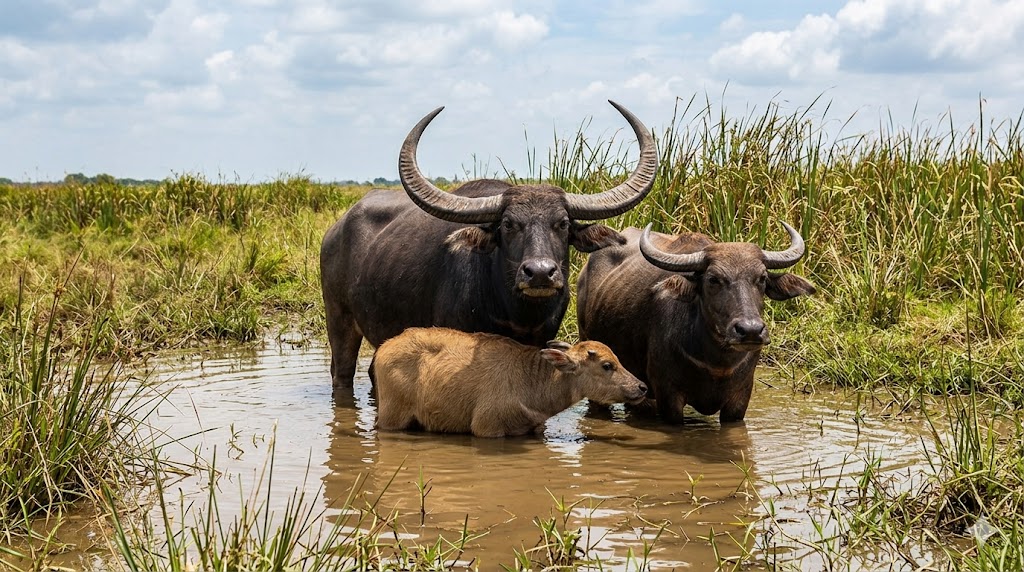
An interesting fact about wild water buffaloes is their absolute dependence on water and mud. They possess fewer sweat glands than most other mammals, making them highly sensitive to the tropical heat. To regulate their body temperature and shield their skin from biting insects or sunburn, they spend a massive portion of the sweltering day completely submerged up to their nostrils in rivers, marshes, or deep mud wallows. Furthermore, true wild water buffaloes are remarkably protective and aggressive; if a herd senses a threat to their calves, they will pack tightly into a defensive wall and actively counter-charge predators—even mature Sri Lankan leopards—frequently driving them away with ease
Scientific Name
Bubalus arnee
Sinhala Name
කුළු මීහරකා (Kulu Meeharaka)
Weight
700 to 1,200 kg (Adult males are significantly heavier and denser than females).
Length
2.4 to 3.0 meters (Head-to-body length; the tail adds an additional 60 to 100 cm, pushing total length over 3.5 meters).
Male Female appearance Difference
Slightly Different
Female Appearance
Noticeably smaller and more streamlined in build than males, though still exceptionally large. Their horns are relatively slender, grow more vertically upward, and lack the extreme heavy thickness at the horn base seen in dominant bulls.
Male Appearance
Imposing, barrel-chested, and heavily muscled with thick skin armor around the neck and throat. They possess massive, widely sweeping horns that flare outward and curve back toward the tips, frequently achieving a total tip-to-tip span exceeding 1 meter.
Juvenile Appearance
Calves are born with a soft, dense, fluffier coat of light sandy-brown or golden-tan fur. They have clear, dark eyes and completely lack horn development at birth. Their coats darken gradually to the adult charcoal-gray or slate-black palette within 6 months as their horn buds emerge.
Residency
Resident Breeder
Endemism
Native
Conservation Status
Critically Endangered
Mode of Locomotion
Terrestrial, Aquatic
Activity Pattern
Cathemeral)
Child Food
Exclusively mother’s nutrient-rich milk for the first 6 to 9 months, gradually learning to pull up soft aquatic vegetation alongside the herd.
Adult Food
A broad herbivorous diet focused primarily on marsh grasses, reeds, sedges, and various submerged or floating aquatic plants. They will also browse on terrestrial grasses and low-hanging forest leaves during dry spells.
Food Type
Herbivorous (Plant-derived)
Roosting/Den/Resting Place
They utilize no permanent structure or den. During the intense heat of the day, they rest submerged inside deep mud wallows, slow-moving river bends, or hidden under the deep shade of riverine forest blocks.
Nature of Living Area
They strictly require expansive, low-country wet ecosystems including perennial marshes, alluvial floodplains, swampy river delta borders, and tall-grass savannas with continuous access to clean, permanent water pools.
Living Area Categorization
Forests, Wetlands, Grasslands
Living Climatic Zone
Intermediate Zone, Dry Zone
Genus
Bubalus
Family
Bovidae (Cattle and antelope family)
Order
Artiodactyla (Even-toed ungulates
Class
Mammalia
Phylum
Chordata
Kingdom
Animalia
Domain
Eukaryota
lifespan
In the Wild: 20 to 25 years , In Captivity: Up to 28 to 30 years
Gestation Period
Approximately 10 to 11 months (around 300–340 days; the longest gestation among bovine species).
Sexual Maturity
Females: 2 to 3 years ,Males: 3 to 4 years (Though young bulls rarely get to compete successfully for breeding rights until they achieve peak body mass at around 6 to 7 years old).
Mating Season
Breeding can take place year-round, but a major peak in tracking, fighting, and mating activity is timed to match the end of the rainy season, ensuring calves are born when wetlands are fully flooded and vegetation is at its richest.
Parental Care
Extensive maternal care provided within a cooperative herd framework. The mother closely guards and nurses her calf, but the entire female-led herd acts in unison to shield calves from danger, forming a protective perimeter around the young when predators approach.
Social Structure
Highly gregarious matriarchal social groups called herds, typically consisting of 10 to 30 individuals led by an old, experienced cow. Adult bulls are mostly solitary or form small bachelor groups, joining the main female herds only during breeding periods.
Predators
Healthy full-grown adults have no natural mammalian predators on the island due to their immense power. However, young calves or sick individuals can be targeted by the Sri Lankan leopard (Panthera pardus kotiya) or ambushed by massive mugger crocodiles at watering holes.
Prey
None (strictly herbivorous).
Places to see the animal
Yala National Park, Bundala National Park, Udawalawe National Park, Wilpattu National Park, Kumana National Park (Yala East), Kitulgala Rainforest (Makandawa Forest Reserve), Wasgamuwa National Park, Maduru Oya National Park, Somawathiya National Park
Voice
They communicate using an array of deep, gravelly vocalizations, including loud, resonant guttural snorts, low grunts to maintain herd cohesion, and sharp, explosive blowing sounds when alarmed or preparing to charge.
Distribution within Sri Lanka
Strictly confined to the large, protected low-country national parks and sanctuary wetlands of the southern, eastern, and north-central dry-zone plains. They are completely absent from the wet southwest and high-altitude central mountains.
Global Distribution
Highly fragmented across South and Southeast Asia, with remaining isolated wild populations restricted to small pockets in India, Nepal, Bhutan, Thailand, Cambodia, and Sri Lanka.
Human Interactions
Genetic Pollution (Hybridization): This is their single most critical threat; because domestic buffaloes roam freely in national park buffers, extensive interbreeding has polluted the wild gene pool, leaving very few genetically pure Bubalus arnee on the island.
Habitat Loss: The drainage and conversion of natural floodplains and marshes for large-scale rice cultivation directly destroys their foraging ecosystems.
Hunting: Occasionally targeted illegally by poachers for wild bushmeat or for their massive trophy horns.

Comments (3)
www.555329.com,
10 October, 2026If you are mad at me, just curse me out
pornip,
10 October, 2026Its Amazing
555329,
10 October, 2026Hi,how are you