
- 14 Views
- 5 Min Read
- (0) Comment
The Monarch of the Wilds: The Mighty Sri Lankan Sambar Deer
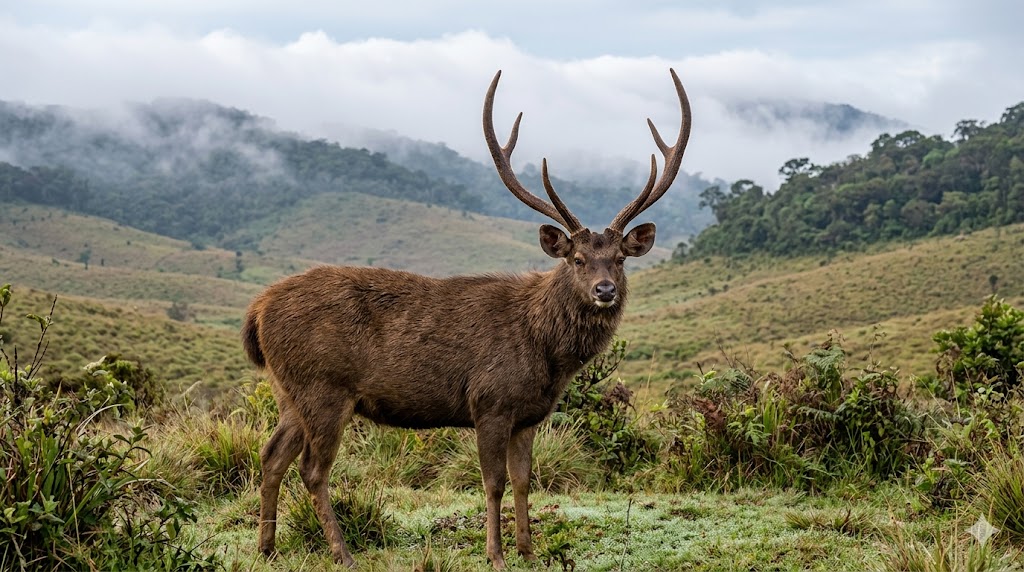
If you rise early enough in the high-altitude cloud forests of Horton Plains, or track the deep shadows of the lowland scrublands at twilight, you might encounter a specter that commands absolute silence. Rising from the mist like a creature from a forgotten epoch, it stands over a meter tall at the shoulder, its coat a deep, charcoal brown, wrapped in a shaggy, imposing mane.
This is the Sri Lankan sambar deer (Rusa unicolor unicolor), locally revered as the ගෝනා (Gona). Far removed from the delicate, dainty image of its smaller cousin, the spotted deer, the sambar is a heavy-duty masterpiece of the forest—the island’s largest deer species, an exceptional swimmer, and the undisputed heavyweight champion of Sri Lanka’s hoofed herbivores.
Engineering of a Giant: Power and Adaptation
To fully appreciate the sambar, one must look at its sheer scale. While a female (doe) is a sleek, elegant animal weighing between 130 to 150 kg, a mature male (stag) is a true tank of the jungle, tipping the scales at a massive 160 to 225 kg.
Every inch of their physiology is fine-tuned for a life spent navigating both dense, thorny undergrowth and freezing mountain plateaus.
-
The Rugged Coat: Unlike many deer species whose coats are smooth, the sambar possesses a coarse, shaggy hide that darkens significantly with age. This thick fur provides an insulation barrier against the biting, near-freezing winds of the central highlands while acting as a protective shield against thorns in the dry zone scrublands.
-
The Crown of Bone: Dominant stags carry spectacular, thick, three-tined antlers that can stretch up to a staggering 110 cm in length. These weapons are grown, hardened, and shed in a continuous annual cycle, serving as the ultimate symbol of authority in the wilderness.
-
A Stealthy Silhouette: Despite their massive bulk, sambar are shockingly quiet. They can melt into a thicket of dense fern beds or thick shrubs without snapping a single twig, earning them a reputation among safari trackers as the “ghosts of the forest.”
The Fury of the Rut: Mud, Mane, and Might
While sambar are generally semi-social—with females and their uniquely unspotted, fuzzy light-brown fawns forming small, quiet sisterhoods of 3 to 6 individuals—the stags are notoriously solitary. For most of the year, these old males wander the deep forests alone.
However, when the breeding season (the rut) peaks between November and January, the lowlands and highlands witness a dramatic transformation.
To attract females and terrify rivals, stags undergo a hormonal surge. They vigorously wallow in muddy pools, plastering their dark hides with wet earth to look larger and more intimidating. They furiously rub their heavy antlers against tree bark to leave scent marks, and the shaggy mane along their muscular necks thickens into a formidable ruff.
When two evenly matched stags cross paths, the jungle erupts. They clash their massive bone crowns together in explosive, straining pushing matches, testing each other’s raw power until the weaker male backs down.
From Cloud Forests to Lowland Wetlands
One of the most remarkable traits of the Sri Lankan sambar is its ecological versatility. It is an endemic subspecies that thrives across vastly different microclimates, utilizing a broad, herbivorous diet to survive where other animals might struggle.
The Seasonal Menu
Sambar are highly adaptable feeders, alternating between grazing on fresh seasonal grasses and browsing on woody vegetation.
-
The Canopy Feast: During the dry season, they resort to stripping bark and chewing tender twigs. However, when the Palu (Manilkara hexandra), Wood Apple, and Tamarind trees drop their ripe fruits, sambar will readily venture into open glades to feast on the fallen rewards.
-
The Water Walkers: Sambar are deeply bound to water sources. They are phenomenal swimmers and are frequently spotted wading belly-deep into rivers, lakes, and marshes to graze on nutrient-rich aquatic plants.
The Prey Base of the Apex Predator
In Sri Lanka’s wilderness, the sambar plays an irreplaceable role. Because the island lacks large pack-hunting predators like wolves or tigers, the responsibility of keeping these giants in check falls almost entirely on the Sri Lankan leopard.
A mature sambar represents the ultimate prize for a leopard—a massive, calorie-dense kill that can sustain a big cat for days. Because the stakes are so high, sambar have developed a piercing, metallic honk-like alarm call. When a sambar barks, the entire forest stops to listen; it is a definitive confirmation that a leopard is actively hunting nearby.
A Quiet Crisis: Facing Modern Threats
Despite their size and power, the Sri Lankan sambar is currently classified as Vulnerable. Unlike smaller deer species that adapt well to agricultural fringes, sambar require extensive, continuous forest tracts. They face a multi-front battle for survival:
The Bushmeat Trade: Because of their substantial size, sambar are heavily targeted by illegal poachers for commercial bushmeat.
Linear Infrastructure: Expanding highways and railways slash directly through ancient migration corridors, leading to fatal vehicle collisions.
The Plastic Scourge: In high-altitude tourist zones like Horton Plains, where sambar have become famously habituated to humans, a tragic new threat has emerged. Deer frequently consume discarded plastics and polythene bags left behind by careless visitors, leading to fatal blockages in their digestive systems.
| Fact Sheet | Sambar Deer Profile |
| Scientific Name | Rusa unicolor unicolor |
| Lifespan | 16 to 20 years in the wild |
| Gestation | Roughly 8 months (~240 days) |
| Prime Viewing (Highland) | Horton Plains National Park (highly habituated groups) |
| Prime Viewing (Lowland) | Yala, Wilpattu, Udawalawe, and Wasgamuwa |
Protecting the sambar is not merely about saving a single deer species; it is about safeguarding the very survival of Sri Lanka’s top predators and preserving the wild, untamed spirit of the island’s grandest landscapes.
Leave a comment: