
- 47 Views
- 4 Min Read
- (0) Comment
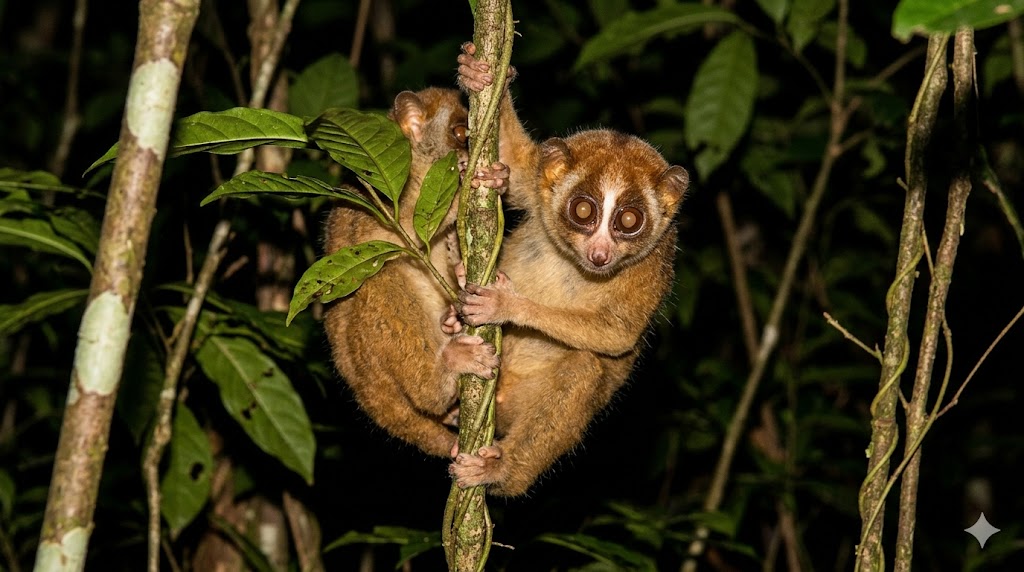
If you walk deep into the dripping rainforests of southwestern Sri Lanka at midnight, turn off your flashlight, and listen closely, you might hear a piercing, high-pitched whistle slice through the damp air. If you trace that sound and click on a red spotlight, you will find yourself staring into a pair of massive, round, glowing amber discs. These belong to the red slender loris (Loris tardigradus), or as it is known in Sinhala, the ශ්රී ලංකා රත් උණහපුලුවා (Rath Unahapuluwa).
Completely endemic to Sri Lanka, this tiny, nocturnal primate looks like a creature stepped straight out of a fantasy novel. Moving with ghost-like deliberation through the dense, vine-tangled canopy, the red slender loris is a beautifully specialized marvel of evolutionary engineering.
The Blood-Vessel Engine and the Cobra Mimic
Unlike their boisterous monkey cousins, the loris cannot jump, leap, or bound between trees. They possess absolutely no external tail. Instead, they navigate the canopy using a slow, highly deliberate, hand-over-hand crawl.
To survive this lifestyle, they have developed two astonishing evolutionary adaptations:
-
The Rete Mirabile: To hold onto branches for hours without tiring, their limbs contain a highly specialized, dense network of intersecting blood vessels called the rete mirabile. This structure allows oxygen-rich blood to pump freely into their tightly-gripping muscles even during static, non-moving holds that would give any human an agonizing muscle cramp.
-
The Cobra Dance: When a loris is cornered by a predator and cannot crawl away, it activates a bizarre defensive trick. It twists its long, slender limbs and body in an eerie, fluid, waving movement that perfectly mimics the swaying stance of an angry, venomous cobra—a spectacle designed to terrify potential enemies.
Silver Infants and the Art of “Infant Parking”
Adult red slender lorises are exceptionally light, weighing between 85 to 170 grams (though the rare highland subspecies can reach 210 grams). Males and females look identical, sporting a plush, reddish-chestnut coat, a white stripe running between their eyes, and impossibly long, pencil-thin legs.
Mating surges occur twice a year, from May to June and October to November. Following a long gestation period of nearly six months, mothers give birth to a single infant that enters the world fully furred with its oversized eyes wide open.
[Infant Born Silver-Grey] ➔ [Clings to Mom's Belly] ➔ [Nightly "Infant Parking" on Branch] ➔ [Matures to Rich Red Coat]
At birth, the infant looks noticeably different from its parents, covered in a soft, woolly, pale silver-gray coat. For the first few weeks, it clings tightly to its mother’s underbelly. As the infant grows too heavy to carry on active hunts, the mother utilizes a survival strategy known as “infant parking.” Before she heads off into the dark to hunt, she carefully hides her baby on a secure, leaf-hidden branch. The infant remains perfectly still and silent all night until the mother returns to retrieve it just before dawn.
The Specialized Canopy Carnivore
While classified as omnivorous because they occasionally snack on sweet forest berries or lick mineral-rich tree gum, the red slender loris is a fierce, highly predatory hunter. They use their exceptional hearing and night vision to stalk a variety of small prey:
-
The Insect Hunt: They actively snatch up fast-moving grasshoppers, crickets, praying mantises, beetles, and forest cockroaches.
-
Vertebrate Prey: They will effortlessly overpower small tree frogs, geckos, forest lizards, and raid sleeping birds’ nests for fresh eggs.
They are incredibly meticulous eaters; before consuming an insect, they will carefully groom off toxic hairs or wings. While hunting alone at night, they are actually social creatures. They live in small family networks consisting of a dominant male, a female, and their young, often huddling together into a single, furry ball inside bamboo thickets or tree cavities to sleep during the day.
A Canopy Cut in Two
The red slender loris is currently classified as Endangered. Because they are completely dependent on continuous, interlocking tree branches to travel, they are uniquely vulnerable to the modern pressures facing Sri Lanka’s remaining wild spaces:
Canopy Fragmentation: The clearing of rainforests for tea plantations, agricultural fields, and rural roads creates open gaps in the trees. Because a loris cannot jump, a 5-meter gap completely cuts off their territory, isolating populations.
Overhead Power Lines: When forced to cross gaps created by human developments, lorises will attempt to crawl along uninsulated overhead power lines, resulting in high rates of instant electrocution.
Superstition and Folk Medicine: Tragically, because of their massive, expressive eyes, these gentle primates are targeted by poachers fueled by local folklore. They are captured illegally for use in traditional eye-potions, love charms, and black-magic rituals.
| Fact File | Red Slender Loris Specifications |
| Scientific Name | Loris tardigradus |
| Climate Zones | Wet Zone and Intermediate Zone forests |
| Lifespan | 10 to 12 years in the wild (Up to 18 years in captivity) |
| Main Natural Predators | Forest eagle-owls, wood owls, large pythons, and civets |
Searching the Cloud Forests
Finding a red slender loris requires immense patience, a sharp eye, and an expert guide. Two distinct subspecies live on the island: the lowland variant (L. t. tardigradus), which can be tracked during specialized night walks in the dense rainforests of Sinharaja, Kitulgala, and the Udawatta Kele Sanctuary, and the incredibly rare, woolly montane subspecies (L. t. nycticeboides), which haunts the freezing, wind-swept cloud forests of Horton Plains National Park. Seeing their golden eyes flash in the canopy is an unforgettable glimpse into the deep, ancient magic of Sri Lanka’s forests.


Leave a comment: