
- 19 Views
- 4 Min Read
- (0) Comment
Shadows of the Dry Zone: The Eccentric Life of the Sri Lankan Sloth Bear
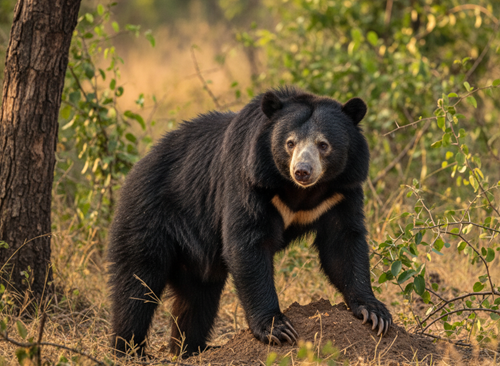
If you wander into the sun-baked scrublands of Sri Lanka at dusk, you might hear them before you see them—a bizarre sequence of intense grunts, deep hums, and a vacuum-like suction noise echoing through the trees. This isn’t the soundtrack of a typical apex predator. It is the unmistakable calling card of the Sri Lankan sloth bear (Melursus ursinus inornatus), locally known as the ශ්රී ලංකා වලසා.
As the island’s only wild bear species, this endemic subspecies is a masterclass in evolutionary eccentricity. Shaggy, highly unpredictable, and structurally engineered to hunt insects, the sloth bear is one of the most thrilling—and deeply respected—encounters in the Sri Lankan wilderness.
Built for the Ultimate Insect Heist
While most bears are broad-diet omnivores that hunt or forage on the ground, the sloth bear is a highly specialized living vacuum cleaner. Evolution has stripped away their two upper central incisor teeth, creating a perfect, permanent gap right at the front of their mouth.
When a sloth bear catches the scent of a hidden colony with its powerful nose, it uses its massive, sickle-shaped ivory claws to rip open concrete-hard termite mounds. It then seals its nostrils shut, uses its highly mobile lips like a funnel, and creates a high-powered vacuum. The resulting sucking noise can be heard over a hundred meters away as it effortlessly inhales thousands of insects in seconds.
The Seasonal Sweet Tooth
Despite their love for termites, sloth bears eagerly pivot their diet when the dry zone flora undergoes its annual transformation. They are excellent climbers, frequently scaling trees to raid bee hives for honey or to gorge on seasonal fruits.
-
The Palu Tree (Manilkara hexandra): During the Palu fruiting season, typically around May and June, sloth bears become borderline obsessed. They will spend hours high up in the branches, completely intoxicated by the sweet, yellow berries.
-
Other Favorites: They heavily target Wood Apple (Limonia acidissima) and the fallen pods of Tamarind and Mango trees.
The Ultimate Backpacker: Maternal Devotion
Life for a female sloth bear (averaging 55 to 70 kg) is a solitary and fiercely protective journey. Unlike most other bear species globally, sloth bear mothers practice a unique method of childcare: they turn themselves into a literal all-terrain vehicle.
After nursing her cubs inside a secure rock crevice or cave for the first few months, the mother introduces them to the wild. To protect her vulnerable offspring from the island’s top predators—namely the Sri Lankan leopard and the Mugger crocodile—she coaxes the cubs onto her back. Clinging tightly to her long, shaggy shoulder fur, the cubs ride shotgun at a full trot until they are roughly six to nine months old, learning exactly where to dig and which fruits to target.
Why the Shaggy Ghost is Feared
Despite their somewhat comical appearance and diet of tiny insects, sloth bears are considered by wildlife trackkeepers to be among the most dangerous animals to surprise in the wild.
Because they share their habitat with leopards, sloth bears evolved an intensely aggressive “fight-rather-than-flight” defense mechanism. They have poor eyesight and average hearing; if a human accidentally stumbles upon a resting bear in thick scrubland, the bear’s instinct is not to run away, but to charge instantly and launch a ferocious, defensive strike to neutralize the perceived threat.
| Quick Fact File | Species Specifications |
| Global Status | Restricted entirely to Sri Lanka (Endemic Subspecies) |
| Conservation | Vulnerable (Threatened by habitat fragmentation and conflict) |
| Lifespan | 20 to 25 years in the wild |
| Best Viewing | Yala, Wilpattu, and Wasgamuwa National Parks |
Conservation and Where to See Them
Today, these magnificent mammals face a quiet crisis. Encroaching agriculture and deforestation force them out of their traditional rocky dens, leading to a spike in accidental human-bear encounters along the borders of the dry zone.
For wildlife enthusiasts, catching a glimpse of a sloth bear requires patience, timing, and a bit of luck. The best opportunity arises during the early mornings or late golden evenings in undisturbed protected areas like Yala National Park or Wilpattu National Park, especially when the Palu trees are heavy with fruit and the shadows of the dry zone come alive.

Leave a comment: